
Pay Per Call KPIs That Tell You Exactly What to Scale and What to Cut
If you've been running pay-per-call campaigns and borrowing your KPIs from a standard PPC playbook, you're measuring the wrong things. A click-based mindset tracks impressions and CTR. A call-based mindset tracks lead quality, call outcomes, and revenue per conversation, and those are completely different data sets.
The most important pay-per-call KPIs are call duration, conversion rate per publisher, cost per call, missed call rate, and revenue per minute (RPM). Get those right, and you'll know exactly which campaigns to scale and which ones to cut.
What Are Pay Per Call KPIs and Why Do They Differ from Standard PPC Metrics?
Pay per call KPIs measure performance based on call quality and call outcomes, not click volume. The core metrics to track are call duration, conversion rate per publisher, cost per call, missed call rate, and revenue per minute (RPM). These indicators reflect lead intent and campaign profitability in ways that click-based metrics simply can't capture.
That distinction matters more than most marketers realize. When you optimize a pay per call campaign using CTR or cost-per-click data, you're looking at traffic behavior, not buyer behavior. Someone who clicks an ad is browsing. Someone who picks up the phone and calls is ready to act. Those two signals require entirely different measurement frameworks.
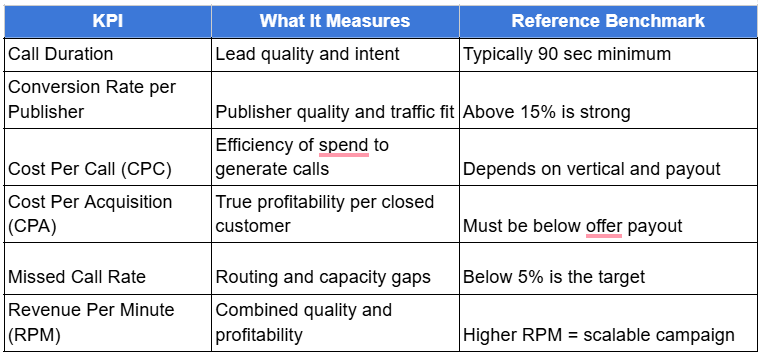
Think of these six metrics as two layers. The first layer, call duration and missed call rate, tells you about operational health. The second layer, conversion rate, cost per call, CPA, and RPM, tells you about financial performance. You need both to run a profitable campaign.
Call Duration: The First Filter for Lead Quality
Call duration is the fastest signal you have for lead quality. A caller who stays on the line for three minutes is engaged. One who hangs up in 20 seconds was never a real prospect.
Most pay per call networks set a minimum qualifying duration between 60 and 90 seconds. That's the billing threshold, not a quality benchmark.
What is a good call duration for pay per call?
It depends on your vertical, but here's a practical reference:
Insurance and legal: 3 to 5 minutes for a genuinely qualified lead
Home services: 90 seconds to 3 minutes
General benchmark: Anything under 2 minutes in high-intent verticals rarely converts
Stop treating the network minimum as your optimization target. Pull your own close rate data and find where your calls actually convert. That number becomes your real threshold.
Duration also works as a publisher filter. A publisher sending 80 calls averaging four minutes beats one sending 200 calls averaging 75 seconds, every time.
Conversion Rate per Publisher: Where Your Budget Is Really Going
Your overall conversion rate can look healthy while two or three publishers quietly drain your budget.
That's why the metric that matters is conversion rate broken down by publisher. Not the campaign average. The individual number.
What to look for
Above 15% per publisher is a strong signal
Below 5% after significant volume means that the publisher needs to be paused or replaced
A wide gap between your best and worst publishers tells you exactly where to reallocate budget
Missed Call Rate: The Leak Most Campaigns Ignore
Every missed call is a lead you already paid for and never converted.
That's not a traffic problem. That's a routing issue, and it's one of the most expensive mistakes in pay per call campaigns.
Missed call rate measures the percentage of inbound calls that went unanswered. The calculation is straightforward:
Total missed calls divided by total inbound calls, multiplied by 100.
What's an acceptable missed call rate?
Below 5% is the target. Anything above that is actively costing you money.
The usual culprits:
Call center capacity limits during peak hours
Poor time-of-day routing configuration
No backup routing when the primary buyer is unavailable
Geographic mismatches between caller location and receiving agent
How to fix it
Set up redundant routing paths so calls never hit a dead end. If your primary buyer misses a call, the system should immediately roll to a secondary destination.
Schedule your highest-traffic hours and make sure your routing reflects them. A campaign generating strong call volume at 7pm needs coverage at 7pm.
Platforms like Ringba and Invoca flag missed calls in real time. If you're not getting that visibility from your current setup, you're optimizing blind.

Revenue Per Minute (RPM): The KPI That Scales Winners
Most marketers track how many calls they get. The ones running truly profitable campaigns track how much each minute of call time is worth.
Revenue Per Minute (RPM) combines call quality and revenue into a single number. It tells you which campaigns are generating real value, not just volume.
Why RPM matters more than raw call volume
Two campaigns can generate the same number of calls and the same revenue. But if one does it in half the call time, that campaign is twice as efficient. RPM surfaces that difference immediately.
How to use it:
Compare RPM across campaigns to identify your top performers
Use it to evaluate publishers beyond just conversion rate
Set an RPM floor below which you pause or restructure a campaign
A high RPM tells you two things at once: your traffic is qualified and your buyers are closing efficiently. That combination is what a scalable campaign looks like.
RPM is the metric that separates marketers who are busy from profitable marketers. Start tracking it and you'll see your campaign decisions get sharper fast.
How to Track All These KPIs Without Managing 5 Different Tools
Knowing your KPIs is one thing. Having a system that tracks all of them in one place is what actually moves campaigns forward.
The typical setup for a pay per call marketer involves separate tools for call tracking, publisher management, landing pages, routing, and reporting. That fragmentation creates blind spots. Data lives in different dashboards, attribution breaks down, and optimization slows to a crawl.
What you actually need in one platform:
Real-time call tracking and attribution by publisher and campaign
Routing controls to reduce missed call rate
Conversion tracking tied directly to call outcomes
Reporting dashboards that surface duration, CPA, and RPM without manual exports
Follow-up automations to recover leads that didn't convert on the first call
Unik360 was built specifically for this. It brings together 25+ tools for pay per call campaign management, including call tracking, landing pages, automations, creatives, and follow-ups, all under a single subscription.
For affiliates and media buyers running multiple campaigns across different verticals, that consolidation is the difference between reacting to data and actually using it.
The simpler your stack, the faster you optimize. Every hour spent pulling reports from four different platforms is an hour you're not spending on the campaigns themselves.
Build Profitable Campaigns from Day One with Unik360
The marketers winning in pay per call right now are not the ones with the most traffic. They're the ones who know exactly what their data means and act on it faster than everyone else.
Call duration, conversion rate per publisher, cost per call, CPA, missed call rate, and RPM give you that clarity. Each one answers a specific question about your campaign. Together, they give you a complete picture of what to scale, what to fix, and what to cut.
The next step is straightforward: start tracking these KPIs from a single platform so your decisions are based on clean, connected data.
Sign up to Unik360 today and run your first campaign with full visibility from day one.
Frequently Asked Questions (FAQs) About KPIs to Track for Pay Per Call Campaign Performance
What is the most important KPI in pay per call marketing?
Call duration and conversion rate per publisher are the two most critical. Duration filters lead quality at the top of the funnel. Publisher conversion rate tells you where your budget is actually working.
How do you calculate cost per call?
Divide your total ad spend by the total number of calls received in a given period. For example, $2,000 spent generating 400 calls equals a $5 cost per call.
How many KPIs should I track for a pay per call campaign?
Focus on six: call duration, conversion rate per publisher, cost per call, cost per acquisition, missed call rate, and revenue per minute. Tracking more than that without a clear system usually creates noise, not insight.